

crest Vectors
 Quiz 13

Close

Question 1

Suppose that P and Q are distinct points in 3-dimensional space. How many planes are there containing both P and Q?
1. None.
2. One only.
3. Two only.
4. An infinite number.
5. A finite number.

Not correct. Choice 1 is false.

Not correct. Choice 2 is false.

Not correct. Choice 3 is false.

Your answer is correct

There are infinitely many planes containing any two given points. To see this, visualise the line joining the points as the spine of a book, and the infinitely many planes as pages of the book.

Not correct. Choice 5 is false.

Question 2

Find the Cartesian equation of the plane through the point (3, 1, 0), perpendicular to i - j + 2k.
1. x - y + 2z = 0
2. x - y + 2z = 4
3. x-y + 2z = 2
4. x - 3y = 0

Not correct. Choice 1 is false.

Not correct. Choice 2 is false.

Your answer is correct

The equation of the plane through the point (p,q,r) perpendicular to ai + bj + ck is a(x - p) + b(y - q) + c(z - r) = 0. Hence in this case, the Cartesian equation is 1(x - 3) - 1(y - 1) + 2(z - 0) = 0; that is, x - y + 2z = 2.

Not correct. Choice 4 is false.

Question 3

Find the Cartesian equation of the plane containing the three points A(1, 3,-1), B(1, 1, 5) and C(-2, 1, 0).
1. 10x + 2y - z = 17
2. 10x + 21y - 6z = 1
3. x + 21y - 6z = 19
4. 10x - 18y - 6z = -38

Not correct. Choice 1 is false.

Not correct. Choice 2 is false.

Not correct. Choice 3 is false.

Your answer is correct

In order to know the equation of a plane, we must know a point on the plane and a vector perpendicular to the plane. We know three points on the plane, so we’re OK there. We can find a vector perpendicular to the plane by using the vector cross product. Notice that the vectors -A-->B  and --->
AC  are both parallel to the plane, so their cross product is normal to the plane. Since --->
AB  = -2j+6k and -A-->C  = -3i-2j+k, we calculate --->
AB  × --->
AC  = 10i-18j-6k. This is a normal vector to the plane. The cartesian equation is therefore 10(x - 1) - 18(y - 3) - 6(z + 1) = 0, or 10x - 18y - 6z = -38.
Question 4

Find the acute angle between the planes 3x + y + z = 0 and x- 2y + z = 3 to two decimal places.

radians

Your answer is correct

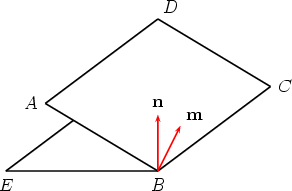
The two planes are obviously not parallel, since the first plane has normal vector n = 3i + j + k and the second plane has normal m = i - 2j + k, and n /|| m. Denoting the planes by ABCD and EBCF (with F obscured), then BC is the line of intersection.
                     D


                                   C
   A               n
                        m


E                  B

Therefore

                    V~ -- V~ --
cosh = -n-· m-=  2/  11  6
       |n ||m |
and from this we get h  ~~  1.32  radians.

Not correct. You may try again.

The answer is 1.32 radians. The concept of “the angle between two planes” is somewhat ambiguous. For example, the line EB lies in one plane, and makes different angles with the lines AB, CB and DB in the other plane. To make it unambiguous, we define the angle h between the two planes to be the angle between the normals n and m to the two planes.
Progress:

right first
    attempt

right

wrong
