I am a Professor of Pure Mathematics in the School of Mathematics and Statistics at the University of Sydney.

University of Sydney, NSW 2006
Australia
- Office
- Carslaw 718
- Phone
- +61 2 9351 6058 (W)
- Fax
- +61 2 9351 4534
-

Research Interests
The representation theory of the symmetric groups, and the closely related cyclotomic Hecke algebras of type A, was transformed when Brundan and Kleshchev's discovery of a grading on these algebras following work of Khovanov-Lauda and Rouquier. The graded theory is harder than the "classical" approach to this subject but it reveals deeper underlying features of the representation theory that we could not see before.
The theory is now best understood in terms of categorification, which gives intimate connections between the symmetric groups and the highest weight representation theory of the quantised affine special linear groups, The underlying problems are still the same - we want to compute the (graded) dimensions and the (graded) decomposition numbers of these algebras - but there is now more structure to work with.
Other active interests include:
- Quiver Hecke algebras and quiver Schur algebras
- Categorification and categorical actions
- Webster's weighted KLR algebras
- Cyclotomic Hecke algebras, complex reflection groups and their braid groups
- The q-Schur algebras and cyclotomic q-Schur algebras
- Algebraic combinatorics, especially that associated with tableaux, Fock spaces and canonical bases
- Cellular algebras
- Affine Hecke algebras
- Quantum groups, canonical bases, and crystal graphs
- Kazhdan-Lusztig theory and cell representations
- Coxeter groups and groups of Lie type, and their representation theory
I am a member of the Algebra research group and an editor for Algebras and Representation Theory and the Annals of Representation Theory.
Publications
See the arXiv and MathSciNet. The versions on the arXiv may differ slightly from the published articles.Preprints
-
The center conjecture for cyclotomic Hecke algebras and cohomology
of quiver varieties
Abstract
For a quiver without edge loops, we construct an isomorphism from the cohomology of a Nakajima quiver variety with coefficients in an arbitrary field to the Jucys--Murphy center of the corresponding cyclotomic KLR algebra over that field. In affine type $A^{(1)}_{e-1}$, combining this with a dimension count shows that this Jucys--Murphy center coincides with the full center in characteristic $0$, when the characteristic does not divide $e$, and when the characteristic equals $e$. This follows from a geometric theorem showing that the sum of these cohomology rings is cocyclic as a module over an integral form of a loop algebra.
As a consequence, we prove that the center of a cyclotomic Hecke algebra of type $G(r,1,n)$ with $q\neq 1$ over any field is generated by symmetric polynomials in its Jucys--Murphy elements, and the same holds over any commutative domain in which $q-1$ is invertible. We also prove a generalization to the integral case of the conjecture of Krylov, Paegelow and Shlykov identifying the equivariant $K$-theory of the core of a Gieseker variety with the cocenter of the generic cyclotomic Hecke algebra, including the natural extension of this conjecture to positive characteristic.
. With , , and . arXiv:2610.25101
Book
-
Iwahori-Hecke algebras and Schur algebras of the symmetric group,
Abstract
This book gives a fully self-contained introduction to the modular representation theory of the Iwahori-Hecke algebras of the symmetric groups and of the associated q-Schur algebras. The main landmarks that we reach are the classification of the simple modules and the blocks of these algebras. Along the way the theory of cellular algebras is developed and an analogue of Jantzen's sum formula is proved. Combinatorial motifs pervade the text, with standard and semistandard tableaux being used to index explicit (cellular) bases. These bases are particularly well adapted to the representation theory. This results in clean and elegant proofs of most of the basic results about these algebras. In the final chapter we give a survey of some recent and exciting developments in the field and discuss open problems.
The book should be accessible to advanced graduate students and also useful to researchers in the field. University lecture series, 15, Amer. Math. Soc., 1999. Errata
Papers
- Cellularity of KLR and weighted KLRW algebras via crystals AbstractWe prove that the weighted KLRW algebras of finite type, and their cyclotomic quotients, are cellular algebras. The cellular bases are explicitly described using crystal graphs. As a special case, this proves that the KLR algebras of finite type are cellular. As one application, we compute the graded decomposition numbers of the cyclotomic algebras. Communications AMS, 6 (2026), 2692-3688. With . arXiv:2309.13867
- Content systems and deformations of cyclotomic KLR algebras of type A and CAbstract This paper initiates a systematic study of the cyclotomic KLR algebras of affine types A and C. We start by introducing a graded deformation of these algebras and the constructing all of the irreducible representations of the deformed cyclotomic KLR algebras using content systems and a generalisation of the Young's seminormal forms for the symmetric groups. Quite amazingly, this theory simultaneously captures the representation theory of the cyclotomic KLR algebras of affine types A and C, with the main difference being the definition of residue sequences of tableaux. We use our semisimple deformations to construct two ``dual'' cellular bases for the non-semisimple KLR algebras of affine types A and C. As applications we recover many of the main features from the representation theory in type A, simultaneously proving them for the cyclotomic KLR algebras of types A and C. These results are completely new in type C and we, usually, give more direct proofs in type A. In particular, we show that these algebras categorify the irreducible integrable highest weight modules of the corresponding Kac-Moody algebras, we construct and classify their simple modules, we investigate links with canonical bases and we generalise Kleshchev's modular branching rules to these algebras. Annals of Representation Theory, 2 (2024), 193–297. With . arXiv:2209.00134
- Cellularity and subdivision of KLR and weighted KLRW algebras AbstractWeighted KLRW algebras are diagram algebras generalizing KLR algebras. This paper undertakes a systematic study of these algebras culminating in the construction of homogeneous affine cellular bases in affine types A and C, which immediately gives cellular bases for the cyclotomic quotients of these algebras. In addition, we construct subdivision homomorphisms that relate weighted KLRW algebras for different quivers. As an application we obtain new results about the (cyclotomic) KLR algebras of affine type, including (re)proving that the cyclotomic KLR algebras of type A(1)e and C(1)e are graded cellular algebras. Math. Annalen, 389 (2024), 3043–3122. With . arXiv:2111.12949
-
Skew cellularity of the Hecke algebras of type G(ℓ,p,n)
Abstract
This paper introduces (graded) skew cellular algebras, which generalise Graham and Lehrer's cellular algebras. We show that all of the main results from the theory of cellular algebras extend to skew cellular algebras and we develop a ``cellular algebra Clifford theory'' for the skew cellular algebras that arise as fixed point subalgebras of cellular algebras.
As an application of this general theory, the main result of this paper proves that the Hecke algebras of type G(ℓ,p,n) are graded skew cellular algebras. In the special case when p = 2 this implies that the Hecke algebras of type G(ℓ,2,n) are graded cellular algebras. The proof of all of these results rely, in a crucial way, on the diagrammatic Cherednik algebras of Webster and Bowman. Our ma in theorem extends Geck's result that the one parameter Iwahori-Hecke algebras are cellular algebras in two ways. First, our result applies to all cyclotomic Hecke algebras in the infinite series in the Shephard-Todd classification of complex reflection groups. Secondly, we lift cellularity to the graded setting.
As applications of our main theorem, we show that the graded decomposition matrices of the Hecke algebras of type G(ℓ,p,n) are uni triangular, we construct and classify their graded simple modules and we prove the existence of ``adjustment matrices'' in positive characteristic. Representation theory, 27 (2023), 508-573. With and arXiv:2106.11459 - Cellularity for weighted KLRW algebras of types B, A(2), D(2) Abstract This paper constructs homogeneous affine sandwich cellular bases of weighted KLRW algebras in types B, A(2), D(2) and finite subquivers. Our construction immediately gives homogeneous sandwich cellular bases for the finite dimensional quotients of these algebras. Since weighted KLRW algebras generalize KLR algebras, we also obtain the bases for (finite dimensional) KLR algebras. J. Lond. Math. Soc., 107 (2023), 1002-1044. With . arXiv:2201.01998
- Gordon Douglas James, 1945–2020 Abstract Gordon James was born in Newcastle-upon-Type on 31 December 1945. He completed his PhD under John Thompson and was the Director of Studies in Pure Mathematics at Cambridge during 1972–1984. In 1985, Gordon moved to Imperial College, London, where he was promoted to Professor in 1989. Gordon was one of the leading experts on the representation theory of the symmetric groups, general linear groups, Hecke algebras and Schur algebras. In addition to his research papers, he wrote a series of influential textbooks in these fields. He is survived by his wife Mary, his children Elizabeth and William, five grandchildren and many very beautiful theorems. Bull. Lond. Math. Soc., 54 (2022), 2561-2584.
-
Positive Jantzen sum formulas for cyclotomic Hecke algebras
Abstract
We prove a "positive" Jantzen sum formula for the Specht modules of the cyclotomic Hecke algebras of type A. That is, in the Grothendieck group, we show that the sum of the pieces of the Jantzen filtration is equal to an explicit non-negative linear combination of modules Eνf,e, which are modular reductions of simple modules for closely connected Hecke algebras in characteristic zero. The coefficient of Eνf,e in the sum formula is determined by the graded decomposition numbers in characteristic zero, which are known, and the characteristic of the field. As a consequence we see that the decomposition numbers of a cyclotomic Hecke algebra at an eth root of unity in characteristic p depend on the decomposition numbers of related cyclotomic Hecke algebras at eprth roots of unity in characteristic zero, for r≥0. Math. Zeitschrift, 301 (2022), 2617-2658. arXiv:2106.15486 -
Fayers' conjecture and the socles of cyclotomic Weyl modules
Abstract
Gordon James proved that the socle of a Weyl module of a classical Schur algebra is a sum of simple modules labelled by p-restricted partitions. We prove an analogue of this result in the very general setting of ``Schur pairs''. As an application we show that the socle of a Weyl module of a cyclotomic q-Schur algebra is a sum of simple modules labelled by Kleshchev multipartitions and we use this result to prove a conjecture of Fayers that leads to an efficient LLT algorithm for the higher level cyclotomic Hecke algebras of type A. Finally, we prove a cyclotomic analogue of the Carter-Lusztig theorem. Trans. Amer. Math. Soc., 371 (2019), 1271-1307. With . arXiv:1602.06631 -
Restricting Specht modules of cyclotomic Hecke algebras
Abstract
This paper proves that the restriction of a Specht module for a (degenerate or non-degenerate) cyclotomic Hecke algebra, or KLR algebra, of type A has a Specht filtration. Sci. China Math., 61 (2018), 299–310. arXiv:1610.09729 -
The irreducible characters of the alternating Hecke algebras
Abstract
This paper computes the irreducible characters of the alternating Hecke algebras, which are deformations of the group algebras of the alternating groups. More precisely, we compute the values of the irreducible characters of the semisimple alternating Hecke algebras on a set of elements indexed by minimal length conjugacy class representatives and we show that these character values determine the irreducible characters completely. As an application we determine a splitting field for the alternating Hecke algebras in the semisimple case. J. Algebraic Combin., 47 (2018), 175–211. With Leah Neves. arXiv:1605.02859 -
Quiver Hecke algebras for alternating groups
Abstract
The main result of this paper shows that, over large enough fields of characteristic different from 2, the alternating Hecke algebras are Z-graded algebras that are isomorphic to fixed-point subalgebras of the quiver Hecke algebra of the symmetric group Sn. As a special case, this shows that the group algebra of the alternating groups, over large enough fields of characteristic different from 2, are Z-graded algebras. We give a homogeneous presentation for these algebras, compute their graded dimension and show that the blocks of these quiver Hecke algebras of the alternating group are graded symmetric algebras. Math. Zeitschrift, 285 (2017), 897–937. With Clinton Boys. arXiv:1602.07028 -
Seminormal forms and cyclotomic quiver Hecke algebras of type A
Abstract
This paper shows that the cyclotomic quiver Hecke algebras of type A, and the gradings on these algebras, are intimately related to the classical seminormal forms. We start by classifying all seminormal bases and then give an explicit ``integral'' closed formula for the Gram determinants of the Specht modules in terms of the combinatorics which utilizes the KLR gradings. We then use seminormal forms to give a deformation of the KLR algebras of type A. This makes it possible to study the cyclotomic quiver Hecke algebras in terms of the semisimple representation theory and seminormal forms. As an application we construct a new distinguished graded cellular basis of the cyclotomic KLR algebras of type A. Math. Annalen, 364 (2016), 1189–1254. With . arXiv:1304.0906 -
Cyclotomic quiver Schur algebras for linear quivers
Abstract
We define a graded quasi-hereditary covering for the cyclotomic quiver Hecke algebras R of type A when e=0 (the linear quiver) or e≥ n. We show that these algebras are quasi-hereditary graded cellular algebras by giving explicit homogeneous bases for them. When e=0 we show that the KLR grading on the quiver Hecke algebras is compatible with the gradings on parabolic category O previously introduced in the works of Beilinson, Ginzburg and Soergel and Backelin. As a consequence, we show that when e=0 our graded Schur algebras are Koszul over field of characteristic zero. Finally, we give an LLT-like algorithm for computing the graded decomposition numbers of the quiver Schur algebras in characteristic zero when e=0. Proc. Lond. Math. Soc., 110 (2015), 1315-1386. With . arXiv:1110.1699 -
Cyclotomic quiver Hecke algebras of type A
Abstract
This chapter is based on a series of lectures that I gave at the National University of Singapore in April 2013. They survey the representation theory of the cyclotomic Hecke algebras of type A with an emphasis on understanding the KLR grading and the connections between the "classical" ungraded representation theory and the rapidly emerging graded theory. They are fairly self-contained and they try to give a leisurely introduction to these algebras, with many examples and calculations that don't appear elsewhere. We make extensive use of the interaction between the ungraded and graded representation theory and try to explain what the grading gives us that we didn't have before. Combinatorics and cellular algebra techniques are used extensively, with a few results from geometry and 2-representation theory being quoted. Highlights include a complete description of the semisimple KLR algebras of type A using just the KLR relations, extensive discussion about graded Specht modules, a proof of the Ariki-Brundan-Kleshchev graded categorification theorem using the graded branching rules, a cellular algebra approach to adjustment matrices and a (possibly optimistic) conjecture for the graded dimensions of the simple modules. in Modular Representation Theory of Finite and p-adic Groups Lecture Notes Series, Institute for Mathematical Sciences, National University of Singapore: Volume 30, World Scientific, 2015. Editors Kai Meng Tan and Gan Wee Teck. arXiv:1310.2142 -
Cyclotomic Carter-Payne homomorphisms
Abstract
We construct a new family of homomorphisms between (graded) Specht modules of the quiver Hecke algebras of type A. These maps have many similarities with the homomorphisms constructed by Carter and Payne in the special case of the symmetric groups, although the maps that we obtain are both more and less general than these. Representation Theory, A.M.S., 18 (2014), 117-154. With arXiv:1310.7474 -
Blocks of the truncated q-Schur algebras of type A
Abstract
This paper classifies the blocks of the truncated q-Schur algebras of type A which have as weight poset an arbitrary cosaturated set of partitions. "Algebraic and Combinatorial Approaches to Representation Theory", Cont. Math., 602 (2013), 123-141, Amer. Math. Soc. With arXiv:1304.3995 -
Universal graded Specht modules for cyclotomic Hecke algebras
Abstract
The graded Specht module Sλ for a cyclotomic Hecke algebra comes with a distinguished generating vector zλ in Sλ, which can be thought of as a ``highest weight vector of weight λ''. This paper describes the defining relations for the Specht module Sλ as a graded module generated by zλ. The first three relations say precisely what it means for zλ to be a highest weight vector of weight λ. The remaining relations are homogeneous analogues of the classical Garnir relations The homogeneous Garnir relations, which are simpler than the classical ones, are associated with a remarkable family of homogeneous operators on the Specht module which satisfy the braid relations. Proc. Lond. Math. Soc., 105 (2012), 1245-1289. With and . arXiv:1102.3519 -
Morita equivalences of cyclotomic Hecke algebras of type
G(r,p,n) II: the (ε,q)-separated case
Abstract
The paper studies the modular representation theory of the cyclotomic Hecke algebras of type G(r,p,n) with (ε,q)-separated parameters. We show that the decomposition numbers of these algebras are completely determined by the decomposition matrices of related cyclotomic Hecke algebras of type G(s,1,m), where 1≤ s≤ r and 1≤ m≤ n. Furthermore, the proof gives an explicit algorithm for computing these decomposition numbers meaning that the decomposition matrices of these algebras are now known in principle.
In proving these results, we develop a Specht module theory for these algebras, explicitly construct their simple modules and introduce and study analogues of the cyclotomic Schur algebras of type G(r,p,n) when the parameters are (ε,q)-separated.
The main results of the paper rest upon two Morita equivalences: the first reduces the calculation of all decomposition numbers to the case of the l-splittable decomposition numbers} and the second Morita equivalence allows us to compute these decomposition numbers using an analogue of the cyclotomic Schur algebras for the Hecke algebras of type G(r,p,n). Proc. Lond. Math. Soc., 104 (2012), 865-926. With . -
Graded induction for Specht modules
Abstract
Recently Brundan, Kleshchev and Wang introduced a Z-grading on the Specht modules of the degenerate and non-degenerate cyclotomic Hecke algebras of type G(l,1,n). In this paper we show that induced Specht modules have an explicit filtration by shifts of graded Specht modules. This proves a conjecture of Brundan, Kleshchev and Wang. International Mathematics Research Notices, 2012 (2012), 1230-1263. With . -
Carter-Payne homomorphisms and Jantzen filtrations
Abstract
We prove a q-analogue of the Carter-Payne theorem in the case where the differences between the parts of the partitions are sufficiently large. We identify a layer of the Jantzen filtration which contains the image of these Carter-Payne homomorphisms and we show how these homomorphisms compose. J. Alg. Comb., 32 (2010), 417-457. With . -
Graded cellular bases for the cyclotomic Khovanov-Lauda-Rouquier
algebras of type A
Abstract
This paper constructs an explicit homogeneous cellular basis for the cyclotomic Khovanov-Lauda-Rouquier algebras of type A over a field.Adv. Math., 225 (2010), 598-642. With . -
A Specht filtration of an induced Specht module
Abstract
Let Hn be a (degenerate or non-degenerate) Hecke algebra of type G(l,1,n), defined over a commutative ring R with one, and let S(μ) be a Specht module for Hn. This paper shows that the induced Specht module S(μ)⊗HnHn+1 has an explicit Specht filtration. J. Algebra, 322 (2009), 893-902. -
Morita equivalences of the cyclotomic Hecke algebras of type
G(r,p,n)
Abstract
We prove a Morita reduction theorem for the cyclotomic Hecke algebras Hr,p,n(q,Q) of type G(r,p,n) with p>1 and n≥ 3. As a consequence, we show that computing the decomposition numbers of Hr,p,n(q,Q) reduces to computing the p'-splittable decomposition numbers of the cyclotomic Hecke algebras Hr',p',n'(q,Q'), where 1≤ r'≤ r, 1≤ n'≤ n, p' divides p and where the parameters Q' are contained in a single (ε',q)-orbit and ε' is a primitive p'th root of unity. J. Reine Angew. Math., 628 (2009), 169-195. With . -
Cyclotomic Solomon Algebras
Abstract
This paper introduces an analogue of the Solomon descent algebra for the complex reflection groups of type G(r,1,n). As with the Solomon descent algebra, our algebra has a basis given by sums of `distinguished' coset representatives for certain `reflection subgroups'. We explicitly describe the structure constants with respect to this basis and show that they are polynomials in r This allows us to define a deformation, or qanalogue, of these algebras which depends on a parameter q. We determine the irreducible representations of all of these algebras and give a basis for their radicals. Finally, we show that the direct sum of cyclotomic Solomon algebras is canonically isomorphic to a concatenation Hopf algebra. Adv. Math., 219 (2008), 450-487. With . -
Seminormal forms and Gram determinants for cellular algebras
Abstract
This paper develops an abstract framework for constructing ``seminormal forms'' for cellular algebras. That is, given a cellular R-algebra A which is equipped with a family of JM-elements we give a general technique for constructing orthogonal bases for A, and for all of its irreducible representations, when the JM-elements separate A. The seminormal forms for A are defined over the field of fractions of R. Significantly, we show that the Gram determinant of each irreducible A-module is equal to a product of certain structure constants coming from the seminormal basis of A. In the non-separated case we use our seminormal forms to give an explicit basis for a block decomposition of A.
In the appendix Marcos shows, under much weaker assumptions, that the theory of seminormal forms rests, ultimately, on the Cayley-Hamilton theorem. J. Reine Angew. Math., 619 (2008), 141-173. With an appendix by . -
Blocks of cyclotomic Hecke algebras
Abstract
This paper classifies the blocks of the cyclotomic Hecke algebras of type G(r,1,n) over an arbitrary field. Rather than working with the Hecke algebras directly we work instead with the cyclotomic Schur algebras. The advantage of these algebras is that the cyclotomic Jantzen sum formula gives an easy combinatorial characterization of the blocks of the cyclotomic Schur algebras. We obtain an explicit description of the blocks by analyzing the combinatorics of `Jantzen equivalence'. Adv. Math., 216 (2007), 854-878. With . -
Cyclotomic Nazarov-Wenzl algebras
Abstract
Nazarov introduced an infinite dimensional algebra, which he called the affine Wenzl algebra, in his study of the Brauer algebras. In this paper we study certain `cyclotomic quotients' of these algebras. We construct the irreducible representations of these algebras in the generic case and use this to show that these algebras are free of rank rn(2n-1)!! (when Ω is admissible). We next show that these algebras are cellular and give a labelling for the simple modules of the cyclotomic Nazarov-Wenzl algebras over an arbitrary field. In particular, this gives a construction of all of the finite dimensional irreducible modules of the affine Wenzl algebra (when Ω is admissible). Nagoya Math. J., 182 (2006), 47-134. With and . (Special issue in honour of George Lusztig.) -
Rouquier blocks
Abstract
This paper investigates the Rouquier blocks of the Hecke algebras of the symmetric groups and the Rouquier blocks of the q-Schur algebras. We first give an algorithm for computing the decomposition numbers of these blocks in the `abelian defect group case' and then use this algorithm to explicitly compute the decomposition numbers in a Rouquier block. For fields of characteristic zero, or when q=1 these results are known; significantly, our results also hold for fields of positive characteristic with q≠1. We also discuss the Rouquier blocks in the `non-abelian defect group' case. Finally, we apply these results to show that certain Specht modules are irreducible. Math. Z., 252 (2006), 511-531. With and . -
Row and column removal theorems for homomorphisms of Specht
modules and Weyl modules
Abstract
We prove a q-analogue of the row and column removal theorems for homomorphisms between Specht modules proved by Fayers and the first author. These results can be considered as complements to James and Donkin's row and column removal theorems for decomposition numbers of the symmetric and general linear groups. In this paper we consider homomorphisms between the Specht modules of the Hecke algebras of type A and between the Weyl modules of the q-Schur algebra. J. Alg. Comb., 22 (2005), 151-179. With . -
Elementary divisors of Specht modules
Abstract
This paper shows that the Gram matrix for the Specht module S(μ) for the Iwahori-Hecke algebra is diagonalizable if and only if the Gram matrix of S(μ') is diagonalizable and we show that the elementary divisors of these matrices differ by the product of the q-hooks lengths of μ. Finally, we determine the elementary divisors of the Gram matrices of the hook partitions. European J. Combinatorics, 26 (2005), 943-964. With . (Special issue showcasing algebraic combinatorics.) -
Matrix units and generic degrees for the Ariki-Koike algebras
Abstract
This paper uses the Murphy basis of the Ariki-Koike algebras to explicitly construct a complete set of primitive idempotents when these algebras are semisimple and q≠1. As a consequence, we obtain an explicit Wedderburn basis for the Ariki-Koike algebras. Finally, we use these idempotents to compute the generic degrees of the Ariki-Koike algebras. J. Algebra, 281 (2004), 695-730. -
Symmetric group blocks of small defect
Abstract
This paper attempts to compute the decomposition numbers of the Hecke algebras algebras of type A for blocks of weight 3. J. Algebra, 279 (2004), 566-612. With . -
Hecke algebras with a finite number of indecomposable modules
Abstract
This paper is a survey of the recent progress in determining the representation type of the Hecke algebras of finite Weyl groups. Representation theory of algebraic groups and quantum groups , Adv. Studies Pure Math., 40 (2004), 17-25. With . -
The representation theory of the Ariki-Koike and cyclotomic
q-Schur algebras
Abstract
This paper is an extended review of the representation theory of Hecke algebras of type G(r,1,n) and the associated cyclotomic Schur algebras. It discusses developments in this area up to 2001. Representation theory of algebraic groups and quantum groups, Adv. Studies Pure Math., 40 (2004), 261-320. -
The representation type of Hecke algebras of type B
Abstract
This paper determines the representation type of the Iwahori-Hecke algebras of type B when q≠±1. In particular, we show that a single parameter non-semisimple Iwahori-Hecke algebra of type B has finite representation type if and only if q is a simple root of the Poincarée polynomial, confirming a conjecture of Uno's. Adv. Math., 181 (2004), 134-159. With . -
Tilting modules for cyclotomic Schur algebras
Abstract
This paper investigates the tilting modules of the cyclotomic q-Schur algebras, the Young modules of the Ariki-Koike algebras, and the interconnections between them. The main tools used to understand the tilting modules are contragredient duality, and the Specht filtrations and dual Specht filtrations of certain permutation modules. Surprisingly, Weyl filtrations -- which are in general more powerful than Specht filtrations -- play only a secondary role. We also develop a theory of Young modules for the Ariki-Koike algebras; as far as we know this is new even for Coxeter groups of type B. J. Reine Angew. Math., 562 (2003), 137-169. -
Equating decomposition numbers for different primes
Abstract
This paper shows that certain decomposition numbers for the Iwahori-Hecke algebras of the symmetric groups and the q-Schur algebras at different roots of unity in characteristic zero are equal. To prove our results we first establish the corresponding theorem for the canonical basis of the level one Fock space and then apply deep results of Ariki and Varagnolo and Vasserot. J. Algebra, 258 (2002), 599-614. With . -
Morita equivalences of Ariki-Koike algebras
Abstract
We prove that every Ariki--Koike algebra is Morita equivalent to a direct sum of tensor products of smaller Ariki--Koike algebras which have q-connected parameter sets. A similar result is proved for the cyclotomic q-Schur algebras. Combining our results with work of Ariki and Uglov, the decomposition numbers for the Ariki--Koike algebras defined over fields of characteristic zero are now known in principle. Math. Z., 240 (2002), 579-610. With , -
The Jantzen sum formula for cyclotomic q-Schur algebras
Abstract
The cyclotomic q-Schur algebra was introduced by Dipper, James and Mathas, in order to provide a new tool for studying the Ariki-Koike algebra. We prove an analogue of Jantzen's sum formula for the cyclotomic q-Schur algebra. Among the applications is a criterion for certain Specht modules of the Ariki-Koike algebras to be irreducible. Trans. Amer. Math. Soc., 352 (2000), 5381-5404. With . -
The number of simple modules of the Hecke algebras of type
G(r,1,n)
Abstract
This paper classifies the simple modules of the cyclotomic Hecke algebras of type G(r,1,n) and the affine Hecke algebras of type A in arbitrary characteristic. We do this by first showing that the simple modules of the cyclotomic Hecke algebras are indexed by the set of `Kleshchev multipartitions'. Math. Zeitschrift, 233 (2000), 601-623. With . -
The irreducible Specht modules in characteristic 2
Abstract
In this paper we classify the irreducible Specht modules over a field of caharacteristic 2. In particular, we prove a conjecture of the first author from 1978 which says that S(2,2) is the only irreducible Specht module which is indexed by a partition which is not 2-restricted and not 2-regular. Bull. Lond. Math. Soc., 31 (1999), 457-462. With . -
Murphy operators and the centre of the Iwahori-Hecke algebras of
type A
Abstract
In this paper we introduce a family of polynomials indexed by pairs of partitions and show that if these polynomials are self--orthogonal then the centre of the Iwahori--Hecke algebra of the symmetric group is precisely the set of symmetric polynomials in the Murphy operators. J. Alg. Comb., 9 (1999), 295-313. -
Cyclotomic q-Schur algebras
Abstract
This paper introduces the Cyclotomic q-Schur algebra, which is a quasi-hereditary cover of the Hecke algebra of the complex reflection group of type G(r,1,n). The cyclotomic q-Schur algebras are a natural generalization of the q-Schur algebras. We construct a cellular basis for these algebras, a complete set of simple modules and show that they are quasi-hereditary algebras. Math. Zeitschrift, 229 (1998), 385-416. With and . -
Symmetric cyclotomic Hecke algebras
Abstract
In this paper we prove that the generic cyclotomic Hecke algebras for imprimitive complex reflection groups are symmetric over any ring containing inverses of the parameters. For this we show that the determinant of the Gram matrix of a certain canonical symmetrizing form introduced by Bremke and Malle is a unit in any such ring. On the way we show that the Ariki-Koike bases of these algebras are also quasi-symmetric. J. Algebra, 205 (1998), 275-293. With . -
The (Q,q)-Schur Algebra
Abstract
In this paper we use the Hecke algebra of type B to define a new algebra S which is an analogue of the q-Schur algebra. We construct Weyl modules for S and obtain, as factor modules, a family of irreducible S-modules over any field. Proc. Lond. Math. Soc., 77 (1998), 327-361. With and . -
Simple modules of Ariki-Koike algebras
Abstract
In this note we classify the simple modules of the Ariki--Koike algebras when q=1 and also describe the classification of the simple modules for those algebras, together with the underlying computation of the canonical bases of the affine quantum group U. Proc. Pure Symp. Math., 63 (1998), 383-396. -
A q-analogue of the Jantzen-Schaper theorem
Abstract
In this paper we prove an analogue of Jantzen's sum formula for the q-Weyl modules of the q-Schur algebra and, as a consequence, derive the analogue of Schaper's theorem for the q-Specht modules of the Hecke algebras of type A. We apply these results to classify the irreducible q-Weyl modules and the irreducible (e-regular) q-Specht modules, defined over any field. In turn, this allows us to identify all of the ordinary irreducible representations of the finite general linear group GL_n(q) which remain irreducible modulo a prime p not dividing~q. Proc. Lond. Math. Soc., 74 (1997), 241-274. With . -
Hecke algebras of type A at q=-1
Abstract
In this paper we study the decomposition matrices of the Hecke algebras of type~A with q=-1 over a field of characteristic 0. We give explicit formulae for the columns of the decomposition matrices indexed by all 2-regular partitions with 1 or 2 parts and an algorithm for calculating the columns of the decomposition matrix indexed by partitions with 3 parts. Combining these results we find all of the rows of the decomposition matrices which are indexed by partitions with at most four parts. All this is accomplished by means of a more general theory which begins by showing that the decomposition numbers in the columns of the decomposition matrices indexed by 2-regular partitions with `enormous 2-cores' are Littlewoord-Richardson coefficients. J. Algebra, 184 (1996), 102-158. With . -
On the left cell representations of Iwahori--Hecke algebras of
finite Coxeter groups
Abstract
On the left cell representations of Iwahori-Hecke algebras of finite Coxeter groups In this paper we investigate the left cell representations of the Iwahori-Hecke algebras associated to a finite Coxeter group W. Our main result shows that Tω, where ω is the element of longest length in W, acts essentially as an involution upon the canonical bases of a cell representation. We describe some properties of this involution, use it to further describe the left cells, and finally show how to realize each cell representation as a submodule of H. Our results rely upon certain positivity properties of the structure constants of the Kazhdan-Lusztig bases of the Hecke algebra and so have not yet been shown to apply to all finite Coxeter groups. J. Lond. Math. Soc., 54 (1996), 475-488. -
Some generic representations, W-graphs, and duality
Abstract
This paper begins by generalising the notion of `W--graph' to show that the W-graph data determines not one but four closely related representations of the generic Hecke algebra of an arbitrary Coxeter group. Canonical `Kazhdan-Lusztig bases' are then constructed for several families of ideals inside the Hecke algebra of a finite Coxeter system (W,S). In particular for each J⊆ S we construct the left cell module corresponding to the `top' left cell CJ as a submodule of the Hecke algebra and give a precise description of its canonical basis. In the case of the symmetric group it is shown that every irreducible representation arises as a top cell representation. Finally analogues of the representations considered are discussed for the case of an infinite Coxeter group. J. Algebra, 170 (1994), 322-353. -
A q-analogue of the Coxeter complex
Abstract
In this paper a q-analogue of the Coxeter complex of a finite Coxeter group W is constructed for the (generic) Hecke algebra Image associated to W. It is shown that the homology of this chain complex, together with that of its truncations, vanishes away from top dimension. The remainder of the paper investigates the representations of Image afforded by the top homology modules of these complexes. In particular necessary and sufficient conditions are given for a specialisation of the Hecke algebra to decompose into a direct sum of its "truncation" representations. J. Algebra, 164 (1994), 831-848.
Code
Sage
I am one of the developers for the Sage-combinat group, an open-source platform for computer calculations in algebraic combinatorics, which is part of the Sage project. I have a large amount of code that is included in the current version of Sage. When I have time to streamline and document the code I will add my implementation of graded Specht modules to Sage.
Gap
I have contributed to the Gap 3 project, including to chevie. (I have to confess that I never liked Gap 4 so I have never used it. As Gap4 is not backwardly compatible my code does not run on it.) The following programs are included in Gap 3.4.4, however, slightly updated versions can be downloaded from Jean Michel's Gap 3 distribution.- Specht A Gap package for calculating decomposition matrices of Hecke algebras of type A
- Murphy These programs implement the Murphy basis of the Iwahori-Hecke algebra of the symmetric group using Chevie, version 3.4.
Other programs
- aTableau A LaTeX package for drawing tableaux, Young diagrams and abacuses.
- bibupdate A python script for updating the references in a BibTeX database file using the AMS MR Lookup web page. The script is not perfect because it uses some fuzzy searches to try and match the paper in the BibTeX database with a paper listed in MathSciNet
- WebQuiz A system for writing web based quizzes using LaTeX and TeX4ht.
Mathematical links
- Abstract algebra on line
- Some related mathematicians
- Women Mathematicians
- Young Mathematicians Network
- Group Pub Forum
- FDList
- Mathematics resources
- TeX
Mathematics preprint archives
- Groups, Representations and Cohomology
- Recent preprints in representation theory
-
Mathematics ArXiv
(Adelaide)
(see also the UC Davis site) - eprint archive


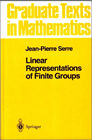
If I were a Springer-Verlag Graduate Text in Mathematics, I would be J.-P. Serre's Linear Representations of Finite Groups.
My creator is a Professor at the College de France. He has previously published a number of books, including Groupes Algebriques et Corps de Classes, Corps Locaux, and Cours d'Arithmetique (A Course in Arithmetic, published by Springer-Verlag as Vol. 7 in the Graduate Texts in Mathematics).
Which Springer GTM would you be? The Springer GTM Test