School of Mathematics and Statistics
Junior


|
 |
Quiz 1: Assumed knowledge Question

DiscussionThis self-assessment quiz should be attempted after having read, and where necessary
revised, the items in Chapter 1 of the printed notes.
The quiz is intended to be first attempted in a single pass – and should take less than 10 minutes. A self-assessed score of 3 or less should be interpreted to mean additional work is required. Any of the questions can be redone at any time.
Question 1
Which if any of the following equations are invalid? Equations involving x are
identities for all x, and f ′ represents df∕dx etc.
Not correct. Choice (a)
is false.
See response (e).
Not correct. Choice (b)
is false.
See response (e).
Not correct. Choice (c)
is false.
See response (e).
Not correct. Choice (d)
is false.
See response (e).
Your answer is correct.
Not correct. Choice (f)
is false.
See response (e).
Question 2
Consider the functions
Not correct. Choice (a)
is false.
See response (c).
Not correct. Choice (b)
is false.
See response (c).
Your answer is correct.
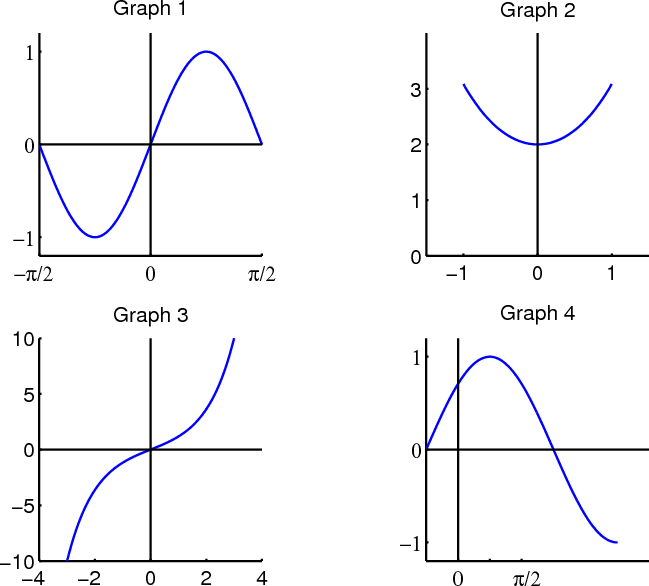
Graph 1 resembles a sine function. Of possibilities A,B,C, it matches only B, in having zeros at x = ±π∕2 (and slope greater than 1 at x = 0, but you need to allow for the different x,y scales to estimate that). Graph 2 resembles a cosh function, and a quadratic. Of possibilities E,F,I, it matches only E in taking the value 2 at x = 0. [cosh0 = 1] Graph 3 resembles a sinh function, and a cubic. Of possibilities G,H, it matches only G, in having non-zero slope at x = 0. [dsinhx∕dx = coshx = 1 at x = 0.] Graph 4 resembles a shifted cosine or sine function. Of possibilities C,D, it matches only D, in having a maximum at x = π∕4 and zeros at x = -π∕4,3π∕4. [C is zero at x = +π∕4.]
Not correct. Choice (d)
is false.
See response (c).
Not correct. Choice (e)
is false.
See response (c).
Question 3
Indicate, using the order shown, whether the following functions are even (e), odd
(o) or neither (n).
(A) e|x| sinx, (B) e|x| cosx, (C) ex sinx.
Not correct. Choice (a)
is false.
See response (d).
Not correct. Choice (b)
is false.
See response (d).
Not correct. Choice (c)
is false.
See response (d).
Your answer is correct.
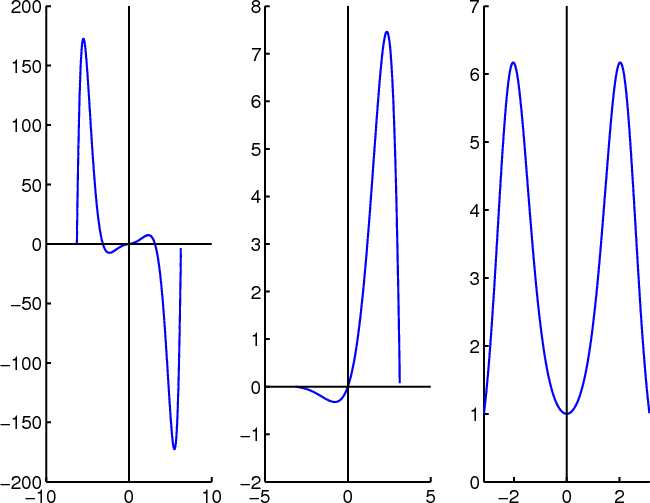
e|x| is even; sinx is odd; cosx is even; ex is neither. So:
A is e × o → o B is e × e → e C is n × o → n Question 4
Match the functions (A) e|x| sinx, (B) e|x| cosx, (C) ex sinx,
to the following graphs, in the order shown.
Not correct. Choice (a)
is false.
See response (b).
Your answer is correct.
The graphs show functions that are o,n,e respectively.
Not correct. Choice (c)
is false.
See response (b)
Not correct. Choice (d)
is false.
See response (b).
Not correct. Choice (e)
is false.
See response (b).
Question 5
Find c1, c2 given that y = e-x(c1 cos2x + c2 sin2x) and
Not correct. Choice (a)
is false.
See response (e).
Not correct. Choice (b)
is false.
See response (e).
Not correct. Choice (c)
is false.
See response (e).
Not correct. Choice (d)
is false.
See response (e).
Your answer is correct.
c1 = 0, c2 = -1∕4
(BC1) ⇒ y(π∕2) = e-π∕2(c1(-1) + c2 sinπ) = 0 I.e. c1 = 0, and hence y = c2 e-xsin2x. (BC2) ⇒ y′′(0) = c2 e0 (-4sin0 - 4cos0 + sin0) = -4c2 = 1. I.e. c2 = -1∕4. | ||||||||||||||||||||||||||||||||||||||||||||||||||||||||||||||||||||


 right first
 right
right wrong
wrong